
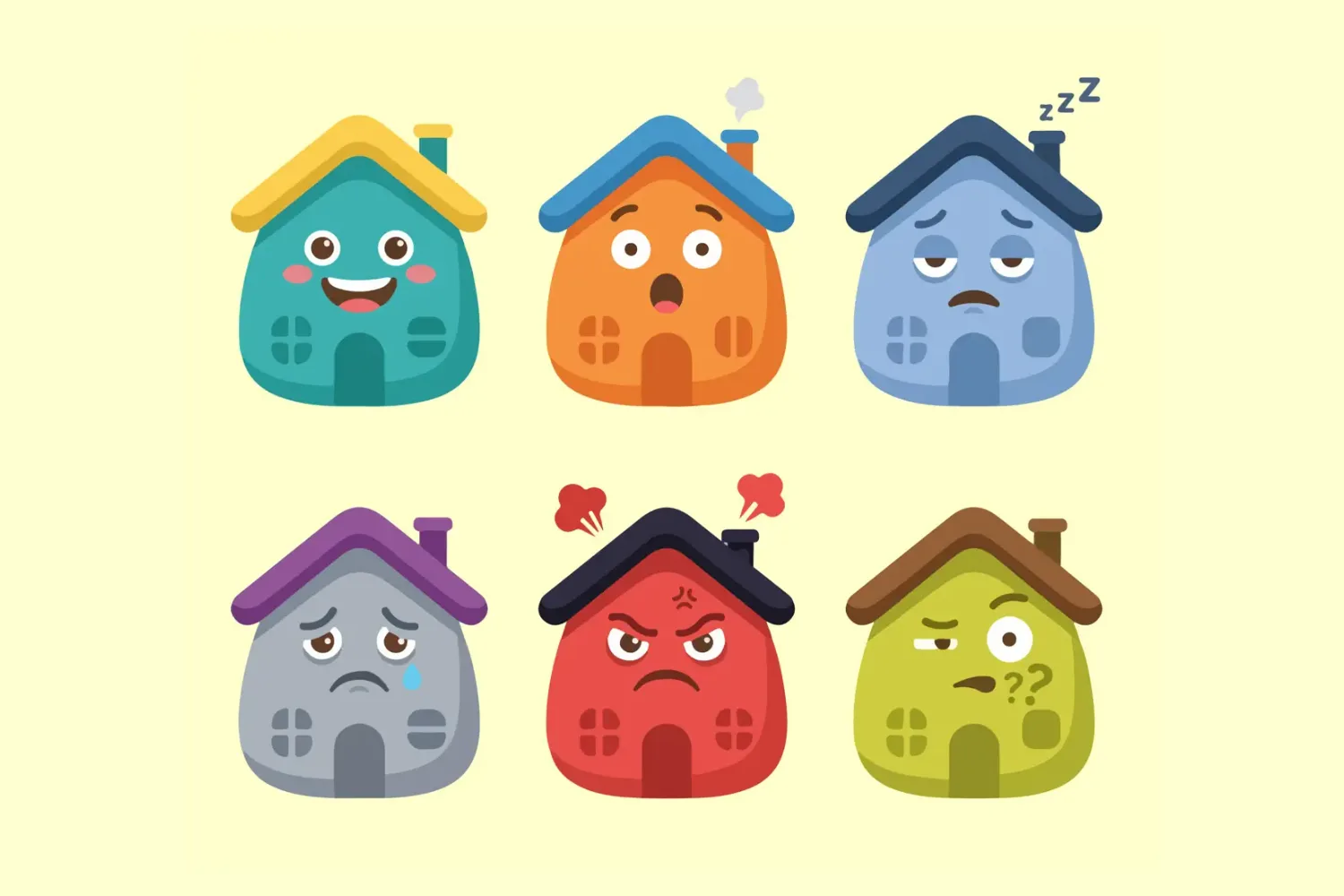
You come home after a day full of meetings, emails and deadlines changed at the last minute. Someone at home asks, “What’s for dinner?”. You answer more sharply than you meant to. Or you don’t answer at all, because all you want is to disappear onto the sofa with your phone. Five minutes later you feel bad, because that person did nothing wrong.
If this sounds familiar, you are not the exception. When I talk about emotions, people regularly tell me that this happens to them. In this article you will learn why it may happen and discover a few ways to help the emotions from work stay outside your front door more often.
Emotions don’t stay at the desk
In psychology we call this phenomenon spillover. The mood in which we finish the working day comes home with us, and then often passes on to the people we live with (crossover).
In a study by Song, Foo and Uy, dual-earner couples answered short mood questions sent to their phones at different times of the day over several days. It turned out that mood from work carried over into the home and then passed on to the partner. This applied to both low and high mood.
Similar conclusions come from research by Prof. Rena Repetti of the University of California, Los Angeles. One of her studies showed that on days with a heavier workload and more tension at work, participants more often reacted at home with anger or withdrawal.
Two faces of carried-over emotions: outbursts and withdrawal
Difficult emotions we carry home usually take two forms. The first is an outburst: irritation, a sharper tone, criticism that on another day would never have come up. The second is withdrawal: we want everyone to leave us alone, we answer in single words, we shut ourselves off.
It is worth knowing that withdrawal is not always harmful. Prof. Repetti studied air traffic controllers. After days with heavy air traffic, the controllers more often withdrew from conversations with their families. When their partners gave them space and support at such times, this temporary withdrawal helped them regain their balance. A short silence after a hard day can therefore be a form of recovery. Provided that our loved ones know what is going on and don’t take it as rejection.
Why does the mind keep working?
Researchers who study recovery from work, Prof. Sabine Sonnentag and Prof. Charlotte Fritz, point to a paradox. We need rest most after a hard day, yet that is exactly when it is hardest to psychologically detach from work. Unfinished tasks, a difficult conversation with a client or an approaching deadline keep coming back in our thoughts, and every such thought keeps our arousal up.
Add tiredness and hunger to this. When we are low on energy, we more readily read ambiguous situations as threatening or irritating. In a study by Dr Jennifer MacCormack and Prof. Kristen Lindquist, hungry participants reacted negatively more often, especially when they did not realise that their bad mood was linked to hunger.
Five ways to keep work emotions from following you through the door
1. Create a transition ritual. Prof. Blake Ashforth and colleagues described how important small rituals are in separating one role from another. When you work remotely, the boundary between office and home practically disappears, so it is worth building it consciously. It might be a short walk around the neighbourhood, a change of clothes, a shower or a particular song at the end of the day. What matters is repeating the same ritual so that it becomes a clear signal: work is over.
2. Close the day on paper. Before you switch off your computer, write down three things you will deal with tomorrow and the first small step for each. This reduces the need to keep track of unfinished tasks all evening.
3. Give your loved ones a heads-up. Instead of disappearing without a word, say: “I’ve had a hard day. I need 15 minutes of quiet.” You can also add: “It’s not about you. I’ll tell you about it once I’ve calmed down a bit.” A message like this turns withdrawal that could hurt into a break your loved ones can support.
4. Name what you are bringing home from work. Simply naming the emotion, for example “I’m still wound up after a difficult meeting” or “I feel disappointed that the project didn’t work out”, helps to separate it from what is happening at home. The emotion from work then doesn’t have to “look for a new target”.
5. Share good news, too. It is not only difficult emotions that spread. Prof. Shelly Gable and colleagues showed that telling our loved ones about pleasant events, and especially their warm and curious response, strengthens both our well-being and the relationship. So at dinner, ask not only “How was your day?” but also “What nice thing happened to you today?”.
And if none of these feels natural to you, the good news is that rest can be learned. In a study by Dr Verena Hahn and colleagues, people who took part in a short recovery training programme detached from work better, felt more competent at recovering and reported better well-being than people in the control group. If you would like to explore recovery further, read my article on recovery or listen to my podcast episode on the psychology of rest (both in Polish).
When is it worth seeking support?
Everyone brings a bad day home sometimes. But if irritability, withdrawal or a sense of exhaustion last for weeks, and your loved ones say more and more often that “there’s no talking to you after work”, it may be a sign that the demands of your job have long exceeded your resources. Then it is worth taking a closer look, for example with the help of a psychotherapist.
Your task for this week
Choose one transition ritual and try it for five working days. Before and after the ritual, rate on a scale from 0 to 10 how much you still feel “at work”. After a week, check whether anything has changed. You could also ask the people you live with whether they have noticed a difference.
It is natural that work sometimes brings us difficult emotions. The point is not to stop feeling them, but to make sure our loved ones don’t have to carry them for us.
Ashforth, B. E., Kreiner, G. E., & Fugate, M. (2000). All in a day’s work: Boundaries and micro role transitions. Academy of Management Review, 25(3), 472-491.
Gable, S. L., Reis, H. T., Impett, E. A., & Asher, E. R. (2004). What do you do when things go right? The intrapersonal and interpersonal benefits of sharing positive events. Journal of Personality and Social Psychology, 87(2), 228-245.
Hahn, V. C., Binnewies, C., Sonnentag, S., & Mojza, E. J. (2011). Learning how to recover from job stress: Effects of a recovery training program on recovery experiences, recovery-related self-efficacy, and well-being. Journal of Occupational Health Psychology, 16(2), 202-216.
MacCormack, J. K., & Lindquist, K. A. (2019). Feeling hangry? When hunger is conceptualized as emotion. Emotion, 19(2), 301-319.
Repetti, R. L. (1989). Effects of daily workload on subsequent behavior during marital interaction: The roles of social withdrawal and spouse support. Journal of Personality and Social Psychology, 57(4), 651-659.
Song, Z., Foo, M.-D., & Uy, M. A. (2008). Mood spillover and crossover among dual-earner couples: A cell phone event sampling study. Journal of Applied Psychology, 93(2), 443-452.
Sonnentag, S., & Fritz, C. (2015). Recovery from job stress: The stressor-detachment model as an integrative framework. Journal of Organizational Behavior, 36(S1), S72-S103.
Story, L. B., & Repetti, R. (2006). Daily occupational stressors and marital behavior. Journal of Family Psychology, 20(4), 690-700.

About the author
Mateusz BanaszkiewiczHealth psychologist
I deliver mental health webinars, lectures and workshops for companies and institutions. On this blog I write about stress, emotions, communication, rest and relationships.
Read next
How to regain a sense of safety after difficult events
What happens to us after difficult social events, and how can we regain calm step by…
13 November 2026 · 22 min read
How to encourage your parents to get health screenings
Why does pushing loved ones to get checked often backfire, and what helps instead?
10 November 2026 · 7 min read
Relaxation techniques
What they are and why they are worth making a permanent part of your life.
5 January 2024 · 3 min read