
Before you start: one minute of calm breathingSettle in and get ready to read with focus. 6 breaths with a longer exhale.
Get comfortable
Breathe in through your nose while the circle grows (4 seconds), then breathe out slowly while it shrinks (6 seconds).
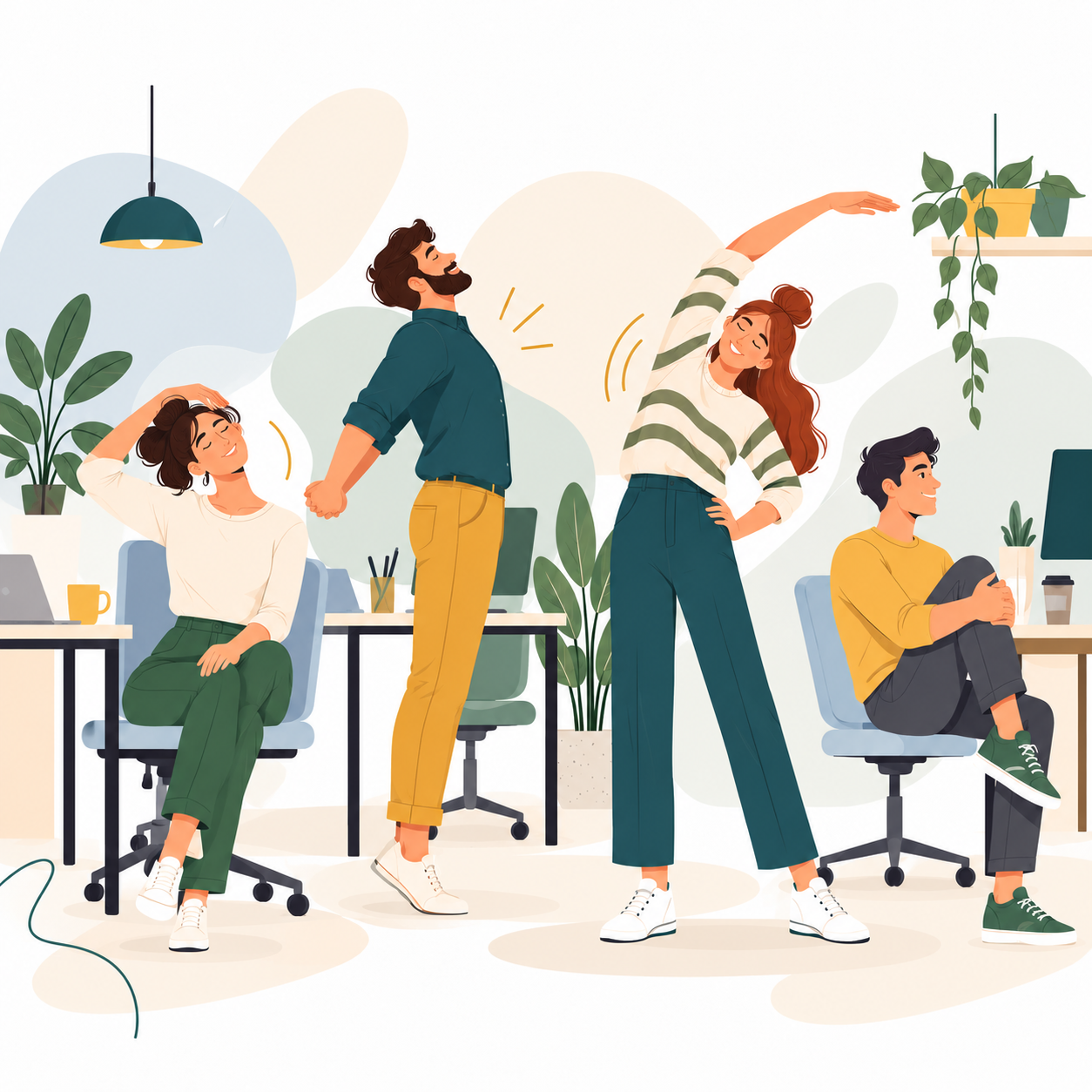
Many of us spend most of the workday at a computer. A body that stays in one position for hours tires more quickly, and that shows in our concentration and wellbeing. The good news is that you don’t need a gym or workout clothes to change this. In this article you will learn what research says about short movement breaks and find six simple exercises you can do at your desk in a few minutes.
Contents4 sections
Why move during the workday?
A systematic review and meta-analysis of research on micro-breaks, short breaks lasting up to 10 minutes, found that they increase vigour and reduce fatigue (Albulescu et al., 2022). A simple change of position can have a similar effect. In a study of office workers with overweight or obesity, switching between sitting and standing every 30 minutes reduced fatigue and lower back discomfort, with no drop in productivity (Thorp et al., 2014).
Movement also helps when the body starts to complain. In a randomised controlled trial, office workers with neck, shoulder and lower back pain who did regular stretching exercises reported clearly less pain. Ergonomic changes to the workstation alone did not produce such a lasting effect (Shariat et al., 2018).
The World Health Organization recommends limiting time spent sitting and replacing it with physical activity of any intensity, as well as doing muscle-strengthening activities at least twice a week (World Health Organization, 2020). Short exercises at work are an easy way to start.
Six exercises for a break from the screen
Do all the exercises in order, or choose one or two that suit you best. Click an exercise to expand it.
1Calf raisesCalves: better circulation in the legs
Stand up straight and rest your hands on the desk or the back of a chair. Tightening your calves, slowly rise onto your toes, then lower your heels just as slowly.
Repeat until your muscles feel pleasantly tired. Do this exercise three times a day.
2Abdominal braceLower back: stability for the lower spine
Stand up and find a stable position. Tighten your abdominal muscles, then place both hands on your lower back.
Gently press your lower back into your hands, drawing your belly backwards, and hold the tension for six seconds. Breathe freely and don’t hold your breath. Repeat three times.
3Apple pickingAbdomen and back: a side stretch
Imagine an apple tree in front of you. For a few seconds, reach with your right hand for apples hanging high on your left, as if they were just out of reach. Then switch hands and reach for the apples on your right.
Keep breathing and notice how the muscles of your abdomen and back pleasantly tense and stretch.
4Spine roll-downBack: releasing the back and neck
Stand up straight with your feet parallel and hip-width apart. Don’t lock your knees, but don’t bend them too much either. Lengthen the crown of your head towards the ceiling, look straight ahead and draw your shoulders away from your ears. Gently pull your shoulder blades together and draw in your belly, keeping the natural curves of your spine.
Take a calm breath in. As you breathe out, bring your chin towards your chest and slowly roll your back down, one vertebra at a time. Let your arms hang loosely, and bend your knees slightly so you don’t push your hips back. Go only as low as feels comfortable.
In this position, swing your arms loosely in opposite directions. Then gently bend one knee, then the other, softly deepening the stretch.
After a few seconds, breathe in, and as you breathe out, slowly roll back up to standing, one vertebra at a time. Finally, lengthen the crown of your head towards the ceiling again.
5PendulumNeck: releasing tension
Lower your chin towards your chest. Slowly swing your head like a pendulum from your right shoulder to your left and back again, keeping your chin close to your chest the whole time.
Avoid tilting your head backwards. Do a few slow repetitions.
6Body tappingWhole body: a quick energy boost
Use both hands to tap different parts of your body in turn: calves, thighs, belly, arms, shoulders and, gently, your face. Repeat the whole sequence three times.
Finally, pause for a moment and notice your breathing, how you feel, the warmth in your body and your energy level.
All six exercises on one A4 page, with a weekly plan to tick off.Download PDF
How to build movement into your workday
Consistency is easiest when movement is linked to something you already do every day. For example, you can:
- do one exercise after every online meeting,
- set an hourly reminder on your phone,
- take some phone calls standing up or while walking,
- invite your team to a one-minute movement break at the start of a meeting.
Your task for this week
Choose two exercises and do them every day, for example after lunch or after your longest meeting of the day. At the end of the week, notice whether anything has changed in your energy and wellbeing. It’s not about effort, it’s about giving your body the moment of movement it needs.
When you need support right now
If you are going through a hard time, you can talk to someone right away. Reaching out is a way of taking care of yourself.
- In Poland: 800 70 22 22, free support for adults in a mental health crisis, 24/7 (chat in Polish at liniawsparcia.pl)
- Elsewhere: findahelpline.com lists free, confidential helplines in many countries
- In an emergency: call your local emergency number (112 in the EU)
Albulescu, P., Macsinga, I., Rusu, A., Sulea, C., Bodnaru, A., & Tulbure, B. T. (2022). “Give me a break!” A systematic review and meta-analysis on the efficacy of micro-breaks for increasing well-being and performance. PLOS ONE, 17(8), e0272460.
Shariat, A., Cleland, J. A., Danaee, M., Kargarfard, M., Sangelaji, B., & Tamrin, S. B. M. (2018). Effects of stretching exercise training and ergonomic modifications on musculoskeletal discomforts of office workers: A randomized controlled trial. Brazilian Journal of Physical Therapy, 22(2), 144-153.
Thorp, A. A., Kingwell, B. A., Owen, N., & Dunstan, D. W. (2014). Breaking up workplace sitting time with intermittent standing bouts improves fatigue and musculoskeletal discomfort in overweight/obese office workers. Occupational and Environmental Medicine, 71(11), 765-771.
World Health Organization. (2020). WHO guidelines on physical activity and sedentary behaviour. World Health Organization.

About the author
Mateusz BanaszkiewiczHealth psychologist
I deliver mental health webinars, lectures and workshops for companies and institutions. On this blog I write about stress, emotions, communication, rest and relationships.
Read next

Why do we take work out on our loved ones? How to keep work emotions from coming home
Anger and tension from work often follow us home. What does the research say, and which…
24 November 2026 · 6 min read
How to regain a sense of safety after difficult events
What happens to us after difficult social events, and how can we regain calm step by…
13 November 2026 · 22 min read
How to encourage your parents to get health screenings
Why does pushing loved ones to get checked often backfire, and what helps instead?
10 November 2026 · 8 min read