Before you start: one minute of calm breathingSettle in and get ready to read with focus. 6 breaths with a longer exhale.
Get comfortable
Breathe in through your nose while the circle grows (4 seconds), then breathe out slowly while it shrinks (6 seconds).
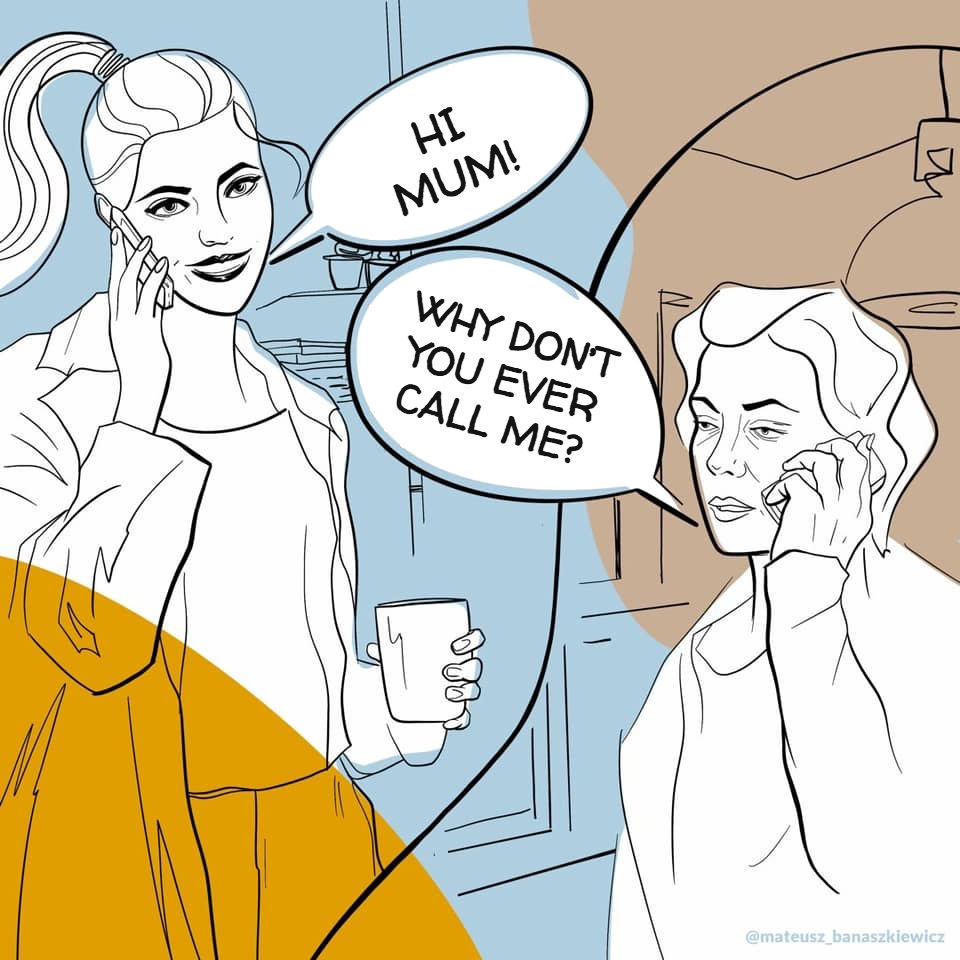
Sometimes the people closest to us communicate in a way that breeds conflict. The kind of communication shown in the comic usually occurs in close relationships. It is an attempt to influence the other person’s behaviour in a way that harms the relationship. Such remarks usually trigger anger, fear, guilt or anxiety. Even if the daughter starts calling her mother more often, it will stem from a sense of obligation rather than from closeness and a deep bond. The mother’s remark is phrased in a way that potentially shifts the blame and responsibility for her own attacking behaviour onto her daughter.
In an ideal world, after a warm greeting, the mother might say something like: “I’ve missed you, darling.”
If the daughter usually responds in such situations by lashing out at her mother, both of them may end up feeling even worse, and perhaps not even wanting to talk to each other any more. The original problem will not be solved and may even deepen, while the daughter will avoid calling her mother all the more, lacking the energy to listen to reproaches, for example after a hard week at work.
When dealing with remarks like these, it helps to remember that they stop working when one side does not play along. The daughter could reflect on what usually happened after her previous reactions to her mother’s words. Perhaps the way she used to react left her feeling guilty afterwards, or sad that the relationship had reached this point.
Next, she can consider what she can influence and control in this situation. It may help to change her mindset and try out new ways of responding. If they prove more effective, it may turn out that even though her mother’s behaviour has not changed, the daughter, by setting her boundaries differently, feels better and has a greater sense of control over the situation and over managing her own emotions.
So what could the daughter say that would be constructive? First, it is worth pausing for a moment to consider which needs her mother is expressing so clumsily. Depending on the outcome of this reflection, she can use a technique known as reflecting and, in this case, reply: “You’ve missed me” or “Mum, you’d like me to call more often.” Over time, the next step might be to let her mother know that such remarks hurt, and to set boundaries in the relationship by showing how her mother could express her needs differently. The most realistic approach, however, is to remember that what she can influence above all is her own reactions.
For your organisation
This topic for your team
I run research-based webinars and workshops for companies. I can prepare a session on this topic for your team.
If you are going through a hard time, you can talk to someone right away. Reaching out is a way of taking care of yourself.
In Poland: 800 70 22 22, free support for adults in a mental health crisis, 24/7 (chat in Polish at liniawsparcia.pl)
Elsewhere: findahelpline.com lists free, confidential helplines in many countries
In an emergency: call your local emergency number (112 in the EU)
Know someone who might find this useful?
About the author
Mateusz BanaszkiewiczHealth psychologist
I deliver mental health webinars, lectures and workshops for companies and institutions. On this blog I write about stress, emotions, communication, rest and relationships.