
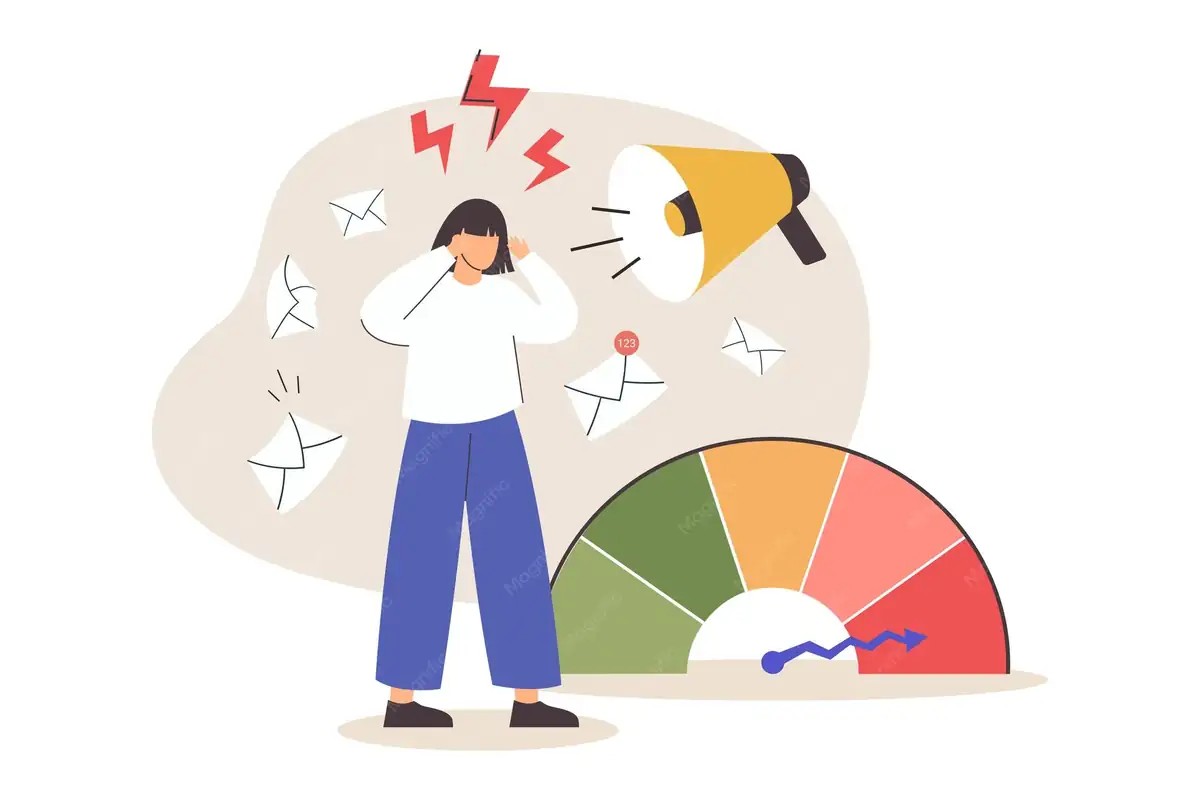
When we are experiencing intense emotions and something catches us off guard, we may react immediately and say or do something we later regret: from eating an extra helping to saying a few words too many or sending an angry email. At such moments our head turns into a nuclear power plant spinning out of control. Fortunately, the brain also has a way to cool the reactor. Using it consciously can make your life easier and improve your relationships with others.
The hot and the cool system
Psychologists Janet Metcalfe and Walter Mischel described two ways in which we process what is happening. The “hot” system is fast, emotional and geared towards immediate reaction. The “cool” system is slower and allows us to think about the consequences. Which one takes over depends largely on what we focus our attention on and how much time we have (Metcalfe & Mischel, 1999).
Stress tips the balance towards the hot system. Strong arousal weakens the prefrontal cortex, which is responsible for planning and inhibiting impulses, and strengthens fast, habitual reactions (Arnsten, 2009). That is why it is so easy to “explode” under pressure, even if we usually see ourselves as calm people.
When are we more prone to impulses?
Most often when we are tired, overloaded or short of sleep. In one study, after a night without sleep the amygdala responded to unpleasant images about 60% more strongly, and its connection with the prefrontal cortex was weaker (Yoo et al., 2007). If you know you have had a hard day, treat it as a warning sign: this is not the best moment for important conversations and decisions.
Why doesn’t “letting it out” help?
Shouting, blaming and judging are habits we have practised since childhood. They take little effort and give us a moment of satisfaction. Many people believe anger needs to be vented, but research does not support this. A meta-analysis of 154 studies involving more than 10,000 people showed that venting anger does not reduce it and may even intensify it. Anger and aggression were reduced by activities that lower arousal: slow breathing, muscle relaxation, yoga and mindfulness (Kjærvik & Bushman, 2024).
Constant dwelling works in a similar way. People who spent a few minutes after a provocation thinking about what had upset them later reacted more aggressively even to a minor annoyance from someone else entirely (Bushman et al., 2005). Anger that we keep “chewing on” does not go away. It simply waits for an opportunity.
The “pause and plan” response
Psychologist Suzanne Segerstrom describes a response that is the opposite of “fight or flight”. It lengthens the time between a trigger or an inner impulse and your reaction. It has four steps:
- Notice: rising emotions, thoughts and bodily reactions, such as a tight chest, a clenched jaw or a flushed face. It helps to put the emotion into words, for example “I feel angry” or “I feel dismissed”. In brain imaging studies, simply naming a feeling reduced the amygdala’s response to emotional stimuli (Lieberman et al., 2007).
- Pause: count to five or take a few slow breaths with a longer exhale. Slow breathing strengthens the activity of the parasympathetic nervous system, which lowers arousal (Zaccaro et al., 2018). If you can, give yourself more time: “I’ll get back to you after the meeting” is a perfectly valid answer too.
- Reflect: look at the situation from a different perspective. If someone criticises you, ask yourself whether there is anything useful in what they said and what might have prompted their comment. This kind of reappraisal is one of the more effective ways of regulating emotions, unlike suppressing what you feel (Webb et al., 2012). It also helps to address yourself by name or in the second person, for example “Anna, what matters most to you right now?”. This kind of distance reduced distress and helped people cope better with stressful tasks (Kross et al., 2014).
- Plan and act: think about how you can respond in line with your own standards. What way of communicating will be helpful, and what will be respectful? What do you want to achieve with this conversation?
What does it look like in practice?
It is evening and you receive a short message from your manager: “This presentation isn’t ready to show the client”. You feel your heart rate jump and you already have a sharp reply ready.
- You notice: “I feel angry and ashamed. I want to defend myself straight away”.
- You pause: you put your phone down, take a few slow breaths and decide to reply in the morning.
- You reflect: “What exactly don’t they like? Could they be right about something? Maybe they are also under pressure before the client meeting”.
- You plan and act: in the morning you write: “Thanks for letting me know. Which parts need improving? I want the presentation to be well prepared”.
The difference between these two reactions is a few minutes, but its effects can be felt for weeks.
When the impulse is about food, shopping or your phone
Not every impulse is about anger. Sometimes it is a sudden craving for sweets, a shopping spree or endless scrolling. Here the technique of “urge surfing” can help: instead of acting straight away or fighting the urge, you observe it with curiosity, like a wave that rises, peaks and falls. In a study of smokers, those who learned this technique smoked fewer cigarettes a week later than people in the control group (Bowen & Marlatt, 2009).
How can you turn this into a habit?
Prepare a plan for a specific situation in an “if…, then…” format, for example: “If I feel anger rising, I will take three slow breaths before I reply” or “If I get an irritating message after 8 p.m., I will reply in the morning”. Such plans clearly increase the chances of following through on intentions: a meta-analysis of 94 tests involving more than 8,000 people found a medium-to-large effect (Gollwitzer & Sheeran, 2006). They also helped people control emotional reactions more effectively than an intention alone (Schweiger Gallo et al., 2009).
What happens in the body?
In the “fight or flight” response, the sympathetic nervous system takes the lead: the heart speeds up and the muscles tense. In the “pause and plan” response, the parasympathetic system has more say: the heart slows down, breathing calms and heart rate variability increases. Higher heart rate variability is linked to a greater capacity for self-control (Segerstrom & Solberg Nes, 2007). In this state it is easier to think things through and choose your response consciously.
Why bother? To feel good, look after your health and make sure that temporary emotions don’t lead to lasting consequences.
Arnsten, A. F. T. (2009). Stress signalling pathways that impair prefrontal cortex structure and function. Nature Reviews Neuroscience, 10(6), 410–422. https://doi.org/10.1038/nrn2648
Bowen, S., & Marlatt, A. (2009). Surfing the urge: Brief mindfulness-based intervention for college student smokers. Psychology of Addictive Behaviors, 23(4), 666–671. https://doi.org/10.1037/a0017127
Brackett, M. (2019). Permission to feel: Unlocking the power of emotions to help our kids, ourselves, and our society thrive. Celadon Books.
Bushman, B. J., Bonacci, A. M., Pedersen, W. C., Vasquez, E. A., & Miller, N. (2005). Chewing on it can chew you up: Effects of rumination on triggered displaced aggression. Journal of Personality and Social Psychology, 88(6), 969–983. https://doi.org/10.1037/0022-3514.88.6.969
Gollwitzer, P. M., & Sheeran, P. (2006). Implementation intentions and goal achievement: A meta-analysis of effects and processes. Advances in Experimental Social Psychology, 38, 69–119. https://doi.org/10.1016/S0065-2601(06)38002-1
Kjærvik, S. L., & Bushman, B. J. (2024). A meta-analytic review of anger management activities that increase or decrease arousal: What fuels or douses rage? Clinical Psychology Review, 109, 102414. https://doi.org/10.1016/j.cpr.2024.102414
Kross, E., Bruehlman-Senecal, E., Park, J., Burson, A., Dougherty, A., Shablack, H., Bremner, R., Moser, J., & Ayduk, O. (2014). Self-talk as a regulatory mechanism: How you do it matters. Journal of Personality and Social Psychology, 106(2), 304–324. https://doi.org/10.1037/a0035173
Lieberman, M. D., Eisenberger, N. I., Crockett, M. J., Tom, S. M., Pfeifer, J. H., & Way, B. M. (2007). Putting feelings into words: Affect labeling disrupts amygdala activity in response to affective stimuli. Psychological Science, 18(5), 421–428. https://doi.org/10.1111/j.1467-9280.2007.01916.x
Metcalfe, J., & Mischel, W. (1999). A hot/cool-system analysis of delay of gratification: Dynamics of willpower. Psychological Review, 106(1), 3–19. https://doi.org/10.1037/0033-295X.106.1.3
Schweiger Gallo, I., Keil, A., McCulloch, K. C., Rockstroh, B., & Gollwitzer, P. M. (2009). Strategic automation of emotion regulation. Journal of Personality and Social Psychology, 96(1), 11–31. https://doi.org/10.1037/a0013460
Segerstrom, S. C., & Solberg Nes, L. (2007). Heart rate variability reflects self-regulatory strength, effort, and fatigue. Psychological Science, 18(3), 275–281. https://doi.org/10.1111/j.1467-9280.2007.01888.x
Webb, T. L., Miles, E., & Sheeran, P. (2012). Dealing with feeling: A meta-analysis of the effectiveness of strategies derived from the process model of emotion regulation. Psychological Bulletin, 138(4), 775–808. https://doi.org/10.1037/a0027600
Yoo, S.-S., Gujar, N., Hu, P., Jolesz, F. A., & Walker, M. P. (2007). The human emotional brain without sleep: A prefrontal amygdala disconnect. Current Biology, 17(20), R877–R878. https://doi.org/10.1016/j.cub.2007.08.007
Zaccaro, A., Piarulli, A., Laurino, M., Garbella, E., Menicucci, D., Neri, B., & Gemignani, A. (2018). How breath-control can change your life: A systematic review on psycho-physiological correlates of slow breathing. Frontiers in Human Neuroscience, 12, 353. https://doi.org/10.3389/fnhum.2018.00353

About the author
Mateusz BanaszkiewiczHealth psychologist
I deliver mental health webinars, lectures and workshops for companies and institutions. On this blog I write about stress, emotions, communication, rest and relationships.
Read next
What are microaggressions?
Small, often unintended comments that disguise a stereotype as a compliment, and why they matter.
6 November 2026 · 6 min read
How to encourage your parents to get health screenings
Why does pushing loved ones to get checked often backfire, and what helps instead?
3 November 2026 · 8 min read
Relaxation techniques
What they are and why they are worth making a permanent part of your life.
5 January 2024 · 4 min read